



Hydrogen Aviation vs eSAF:
Two Paths to Net-Zero Flight —
Which Wins?
The Rolls-Royce/easyJet hydrogen test raises the question — here is the honest answer
The news that Rolls-Royce and easyJet have successfully tested a jet engine running on 100% hydrogen raises a question that every airline executive, aircraft manufacturer and fuel producer is now asking: should aviation decarbonise through hydrogen propulsion or synthetic SAF? The answer, in short, is both — but on very different timelines and for very different routes. Here is the honest analysis.
What the Rolls-Royce/easyJet Test Actually Proved

Rolls-Royce and easyJet completed ground testing of a modified Pearl 15 engine running on 100% hydrogen at full takeoff power at NASA’s Stennis Space Center in Mississippi. The engine ran on hydrogen across a simulated full flight cycle — start-up, takeoff, cruise and landing. The programme delivered valuable insights into hydrogen combustion, fuel systems and engine integration.
This is genuine progress. But it is progress in engine technology — not in aircraft certification, airframe integration, airport infrastructure or commercial economics. The path from a ground test at NASA Stennis to a certified commercial aircraft carrying 200 passengers is measured in decades, not years.
Why eSAF Has the Shorter Runway to Market


Synthetic SAF — produced from green hydrogen and captured CO₂ via Power-to-Liquid — has one decisive advantage over hydrogen propulsion: it is a drop-in fuel. It works in every aircraft flying today, through every refuelling system in use today, without any modification to aircraft, engines or airports.
This is not a minor convenience — it is the difference between a fuel that can contribute to the 2030 ReFuelEU mandate and one that cannot. No hydrogen-powered commercial aircraft will be certified and operating at meaningful scale before 2035 at the earliest. Every tonne of eSAF produced today can immediately replace fossil jet fuel in the existing fleet.
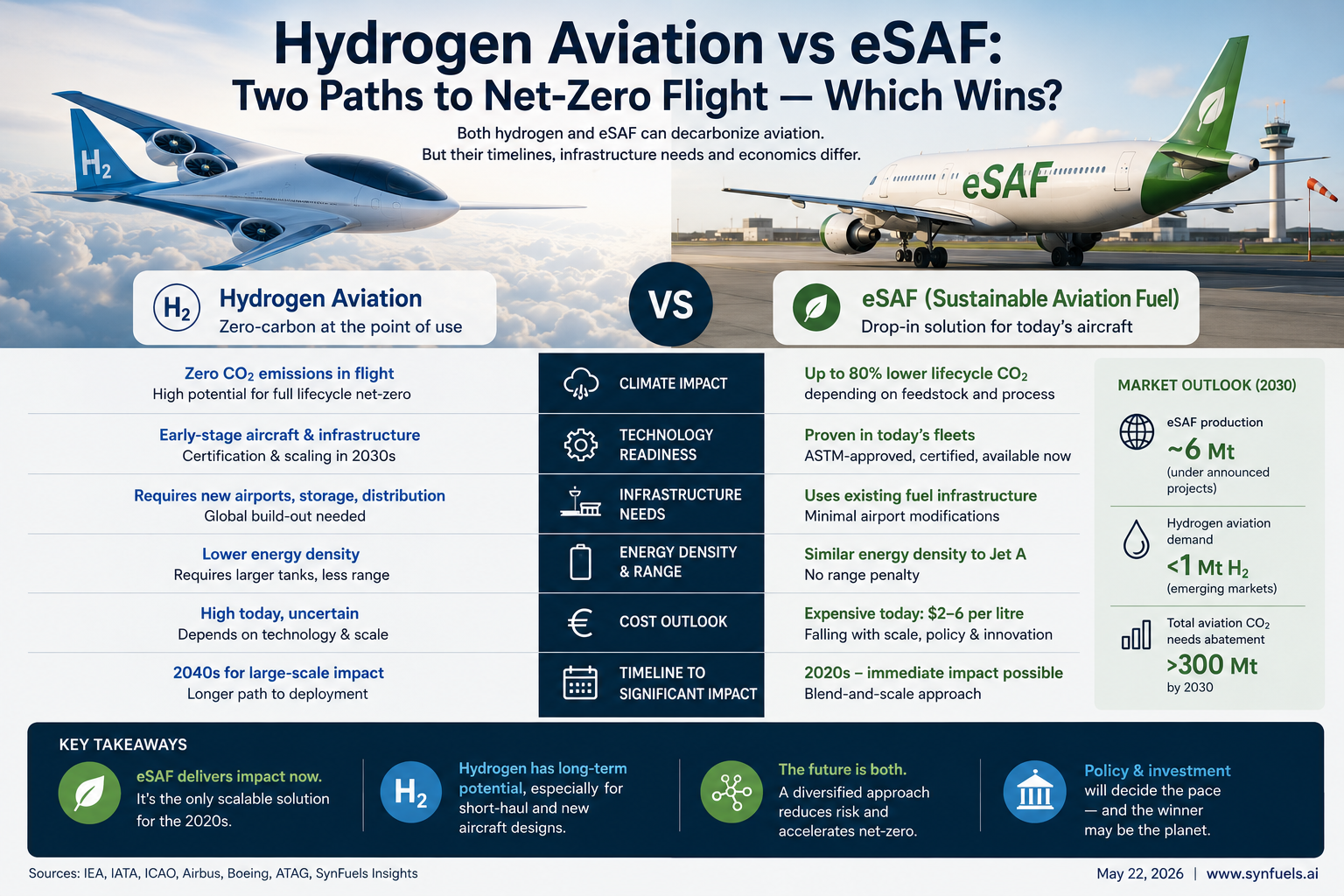
Head-to-Head: eSAF vs Hydrogen Aviation
The Complementarity Argument — Not Either/Or
The most useful frame is not competition but complementarity. Hydrogen-powered aircraft could help significantly reduce carbon emissions across short-haul European aviation — while eSAF serves the long-haul routes, the existing fleet, and all routes where hydrogen aircraft are not viable.
Moreover, both pathways are building the same underlying infrastructure: green hydrogen production. Every electrolyser installed for an eSAF plant reduces the cost of green hydrogen for future hydrogen aircraft. The two pathways are symbiotic — investing in eSAF today directly accelerates the hydrogen aviation of tomorrow.
The Realistic Timeline — When Each Technology Delivers
ReFuelEU mandates in force (2% rising to 6% by 2030). EU subsidies active (€6/L). First commercial PtL plants operational: INERATEC ERA ONE Frankfurt, Infinium Roadrunner Texas, LanzaTech FLITE Ghent (79,000 t/yr, €500M). eSAF is the only technology that can contribute to 2030 compliance. Hydrogen aircraft: still in test phase.
eSAF costs projected to fall to €3–5/L as green hydrogen scales toward IEA target of €2/kg. ReFuelEU 20% SAF mandate from 2035 including 5% eSAF. First hydrogen aircraft in commercial service on short routes (Airbus ZEROe programme targets 2035). Both technologies coexist.
Hydrogen aircraft viable for short-haul European routes. eSAF essential for long-haul and the remaining existing fossil-fuel fleet until retirement. ReFuelEU 70% SAF mandate in 2050 — only eSAF can serve long-haul at this scale.
🔗 Also explore: syntheticfuels.ai — global market · e-fuels.ai — EU regulation · synfuels.ai — weekly news · hydrogen.lu — H₂ Luxembourg
Rolls-Royce/easyJet hydrogen test: easyJet official Mediacentre · Rolls-Royce official · GreenAir News May 2026 · AeroTime May 2026.
Swiss/Metafuels partnership: ESG Today May 14, 2026 · GreenAir News May 2026.
EU SAF subsidy €6/L: Reuters · Biofuels International · EU Commission 2026.
ReFuelEU mandates: ReFuelEU Aviation Regulation EU 2023/2405 — official.
IATA SAF Monitor: IATA 2026 — 0.6% SAF share aviation fuel.
LanzaTech FLITE Ghent: LanzaTech official May 2026 — €500M · 79,000 t/yr.
INERATEC ERA ONE: INERATEC official June 2025 · IEA Global Hydrogen Review 2025.
Disclaimer: Documentary portal. Editorial content — not financial advice. BESS Energie SRL · BCE 0698.949.732 · Heusy (Verviers, Belgium) · info@bess.be · e-saf.ai